
FOR IMMEDIATE RELEASE
Arusha, Tanzania – 5 June 2026
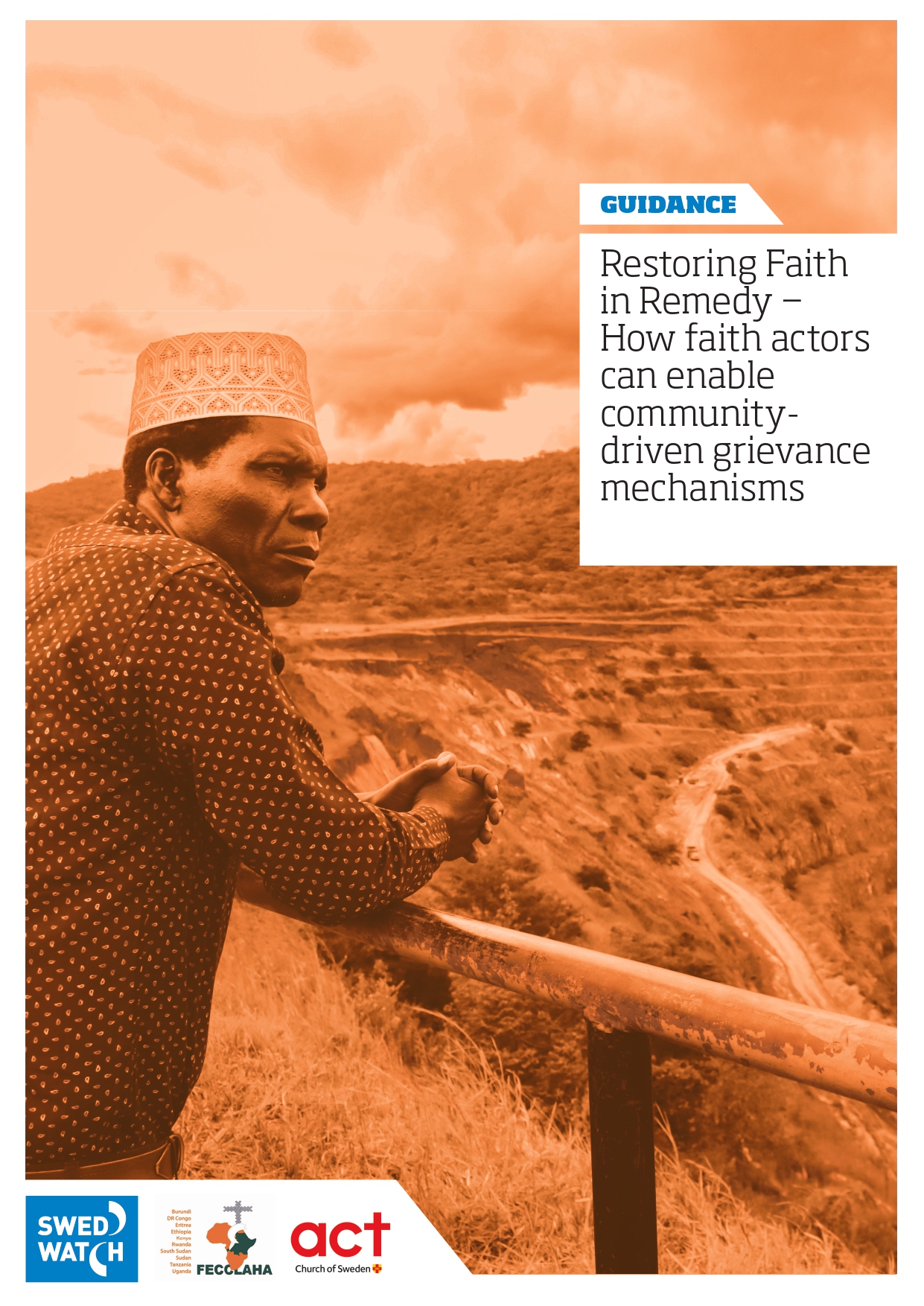
FECCLAHA, Swedwatch, and Act Church of Sweden, with support from the Christian Council of Tanzania (CCT), have launched a new guidance note highlighting the critical role faith actors can play in supporting access to remedy for communities affected by extractive industries.
The guidance note was officially been launched today 5 June 2026, during the Eastern Africa Exchange Platform on Business and Human Rights in Arusha, Tanzania.
The guidance note responds to growing concerns across the Great Lakes and Horn of Africa, where communities continue to experience human rights abuses and environmental harm linked to extractive industries while access to justice and effective remedy remains limited. The publication documents impact including displacement, environmental degradation, health risks, violence, loss of livelihoods, and land rights violations. It also highlights how existing grievance mechanisms are often inaccessible, poorly communicated, and lack community trust.
“Faith actors remain deeply rooted within communities and are often among the first institutions people turn to when facing injustice and harm linked to extractive industries. This guidance recognizes the important role faith leaders can play in supporting dialogue, trust-building, grievance processes, and long-term follow-up toward meaningful remedy and accountability,” said Monica Njoroge, Programme Manager at FECCLAHA.
The guidance also notes that shrinking civic space across the region has made it increasingly difficult for communities and civil society actors to document abuses and engage state authorities and companies, with many facing threats, arrests, violence, and administrative restrictions.
In this context, the guidance calls for stronger collaboration between communities, faith actors, companies, investors, and governments.
“Communities living with the impacts of extractive industries are too often left without meaningful avenues to raise grievances or seek remedy. This guidance shows that solutions exist — but they require aligned action from all actors across the value chain,” said Benjamin Claeson, Programme Officer at Swedwatch and author of the report.
The report identifies faith actors as trusted and locally embedded institutions that can facilitate dialogue, support grievance processes, strengthen conflict resolution, and help communities identify priorities for remedy.
The guidance note includes a foreword by Bishop Nelson Kisare, Chairperson of the Tanzanian Interfaith Standing Committee on Economic Justice and Integrity of Creation (ISCEJIC), and outlines practical recommendations for companies, investors, public buyers, and states across extractive value chains.
Among the key recommendations are:
- Strengthening grievance mechanisms that are safe, accessible, transparent, and community-driven;
- Supporting communities with access to information and alternative pathways to justice;
- Using leverage across value chains to ensure meaningful stakeholder engagement;
- Strengthening collaboration with faith actors and community networks; and
- Enhancing accountability and enforcement of due diligence obligations.
“Ensuring access to remedy is not only a responsibility of extractive companies — it requires coordinated action across value chains. Without this, communities will continue to bear the costs of extraction without recourse,” said Benjamin Claeson.
By placing communities at the centre of grievance processes and recognizing the role of trusted local actors, the guidance calls for a more inclusive, accountable, and people-centred approach to remedy within the extractives sector.
About the Organizations
FECCLAHA is a regional faith-based organization headquartered in Kenya that brings together national councils of churches and faith actors from across the Great Lakes and Horn of Africa to collaborate on peacebuilding, conflict transformation, and social justice initiatives.
Swedwatch is an independent non-profit research organization that examines the impacts of business operations on human rights and the environment.
Act Church of Sweden is a faith and human rights-based actor engaged in international humanitarian action and development cooperation.
The Christian Council of Tanzania (CCT) is an umbrella organization of Protestant denominations and church-related organizations in Tanzania and is a member organization of FECCLAHA.
ENDS
For media inquiries:
Judy Muthoni: judy.muthoni@fecclaha.org
Brighton Katabazi: +255 758118 223- Tanzania